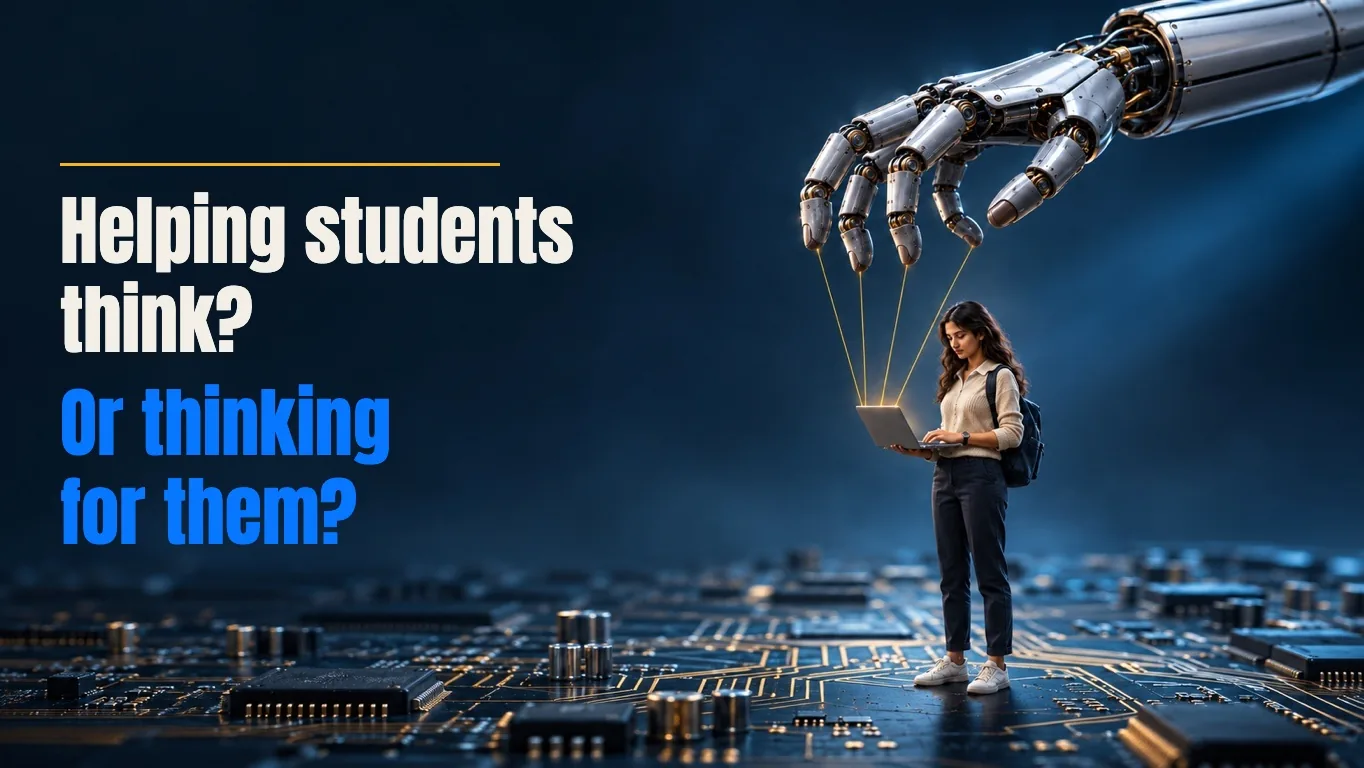
On 10 November 2026 Stanford's SCALE Initiative published an updated review of 52 rigorous studies of generative AI in education. AI was more likely to help when students used it to understand material than when it did the work for them, though neither use reliably improved learning. None of the studies took place in the UAE.
What happened?
The SCALE Initiative at Stanford University, through its AI Hub for Education, published The Evidence Base on AI in K-12: A November 2026 Review. It updates the team's March review with papers published from October 2025 to June 2026, ahead of a full review planned for spring 2027. Of 868 papers added to its research repository in that period, 32 met its standard for strong causal evidence, taking the evidence base from 20 studies to 52.
The review's main findings:
- Letting AI produce the work can cost learning later. Brazilian undergraduates who prepared with ChatGPT spent 3.2 hours rather than 5.8, but those who used traditional resources scored higher on a surprise test 45 days later. On a US maths practice platform, the odds of a correct answer on supervised problems that are easy to type into a chatbot fell by about 25% compared with graph-based problems.
- Using AI to learn is more promising, but results are mixed. In Sierra Leone, teacher-led use of Google's Gemini Guided Learning raised the maths scores of 1,423 grade 7 and 8 students by 0.258 standard deviations; Google's LearnLM team ran the trial with Fab AI. In the US, adding an AI tutor to maths practice for 6,997 grade 6 to 8 students slowed them down and gave no overall gain on a later test.
- Design matters, but it is not yet clear which features count. In an earlier trial with about 1,000 high-school students in Türkiye, unrestricted GPT-4 raised practice grades but cut unassisted exam scores by 17%; a version that used teacher-provided guidance and withheld answers avoided the drop.
- Feeling helped is not the same as learning. Students often rated AI as a better experience even where their results did not improve.
The authors are plain about the limits. Most papers are preprints that have not been peer reviewed. An AI model made the first sort of the papers, so relevant studies may have been missed. Most new studies were at universities rather than schools. No study yet shows long-term learning gains, and the review has little to say about whether AI narrows or widens gaps between students. Its advice is addressed to education leaders: judge a specific tool against its goal in your own setting, and measure learning after the AI is taken away.
What this means for UAE families
None of the 52 studies took place in the UAE or the wider Gulf, so treat the findings as a guide, not a verdict. The study closest to a Dubai classroom is one from the March review: 344 Year 10 students in England, the year in which students at many of Dubai's British-curriculum schools begin their IGCSE courses. Students who took notes, on their own or alongside a chatbot, understood and remembered more than those who used only the chatbot, even though the students preferred the chatbot and rated it more helpful. For an IGCSE student revising at home, the review's line between AI that explains and AI that answers is the distinction that matters, and it fits what our guide to revision techniques that work for GCSE and IGCSE students says about active recall.
AI is already part of school life here. The Ministry of Education made AI a subject in public schools from KG to Grade 12 in the 2025-26 academic year. On 2 September 2026 the UAE Cabinet approved "the implementation of an artificial intelligence curriculum across all public and private schools in the UAE"; its announcement does not say how or when private schools must introduce it. In Dubai's private schools, KHDA, DP World Foundation and MIT RAISE launched an AI literacy programme in February for Years 7 to 9 (Grades 6 to 8). It starts with pilots in select schools before a broader rollout and runs until February 2030. KHDA's FutuReady framework, which applies to all private schools in Dubai, lists "clear, well-defined school policies on digital literacy and the responsible use of AI" among the practices it asks schools to consider. The National reported on 1 October that KHDA plans clearer rules on AI use from next year. KHDA has not published them yet.
For students taking IGCSE, A-Levels or the IB Diploma, the rules that count most are the exam boards', and they differ. Cambridge International, whose guidance applies to all its qualifications, requires every use of generative AI to research, write or plan coursework to be acknowledged. Unacknowledged use may be treated as malpractice, and teachers must be able to confirm coursework is the student's own. Pearson's February 2026 note for International GCSE English Language A coursework goes further: students "should not use AI tools to help research, plan, source quotes, check, write or improve their coursework assignments". JCQ, which covers UK GCSEs and A-Levels, permits acknowledged use but gives no credit for work that is not the student's own. The IB will not ban AI, but it does not treat work produced even partly by AI as the student's own, and it requires the tool to be credited in the text and the bibliography. That matters for the Extended Essay, internal assessments and the TOK essay. Many Dubai schools offer more than one of these routes, so a family can face more than one board's rules.
Written exams are sat under supervision without these tools, whichever board a student takes. That is where the review's warning lands for Dubai families. A student who lets AI finish homework problems may look fine on the homework and then find the gap in the exam hall; the maths-platform finding points the same way. The review's own test for schools, learning measured after the AI is taken away, translates directly to home: can your child explain the topic, or answer a past-paper question, with the laptop closed? Active recall, answering from memory rather than rereading, is that same test built into revision.
For teachers
Time saved. An earlier trial with 259 Year 7 and 8 science teachers in 68 schools in England found that ChatGPT, used with a guide, cut lesson-preparation time by about 25 minutes a week (31%) with no drop in quality.
A caution. In Türkiye, giving 193 teachers of 2,816 students in grades 5 to 12 a broad AI teaching chatbot for a semester lowered students' motivation and confidence, even though students were not told about it. Average exam scores did not change, but scores fell for students of lower-performing teachers. The teachers mostly used the tool to generate materials and accepted them with little revision.
Feedback. At US universities, teaching assistants given AI-suggested comments gave more, and better-rated, feedback without spending longer. In Germany, students in grades 10 and 11 who received essay feedback from GPT-4 revised and wrote as well as those who received teacher feedback. In a US study of 874 teachers, AI summaries of assignment reports led more students to start and finish assignments, but scores did not rise.
The authors' advice to schools is to evaluate a specific tool against its purpose in their own setting, looking at student learning and motivation as well as teacher workload. For a Dubai school writing the AI policy that KHDA's framework describes, that is a practical test to build in.
Key takeaway
The strongest evidence so far says AI is more likely to help when it explains and guides than when it produces the work, and even then results vary. For UAE families, the useful checks are whether learning holds up without the tool and what your child's exam board allows in coursework.
What should you do?
- Ask your child's school for its AI policy: what students may use AI for, in homework and in coursework, and how use must be acknowledged.
- Read the exam board's AI guidance for each coursework subject (Cambridge, Pearson, JCQ or the IB, linked below). Rules can differ between subjects on the same board.
- Make sure your child knows that undeclared AI use in coursework can be treated as malpractice — and that some subjects don't allow AI at all.
- Check learning without the tool: ask your child to explain a topic, or answer a question from memory, with no screen.
- Read the review itself, including its limitations, before drawing firm conclusions from any single study.
How this was made
This update was written with AI assistance. On 14 November 2026 its facts were checked against the full Stanford review, including its appendix and methods, and against the UAE Cabinet, WAM, Government of Dubai Media Office, KHDA, Cambridge International, Pearson, JCQ and IB documents listed below. The report of KHDA's planned rules comes from The National, as stated. It was reviewed by the GetYourTutors Academic Team before publishing. GetYourTutors has no connection with Stanford University or with any AI tool named here. The image at the top of this page is an illustration and does not show a real student.